

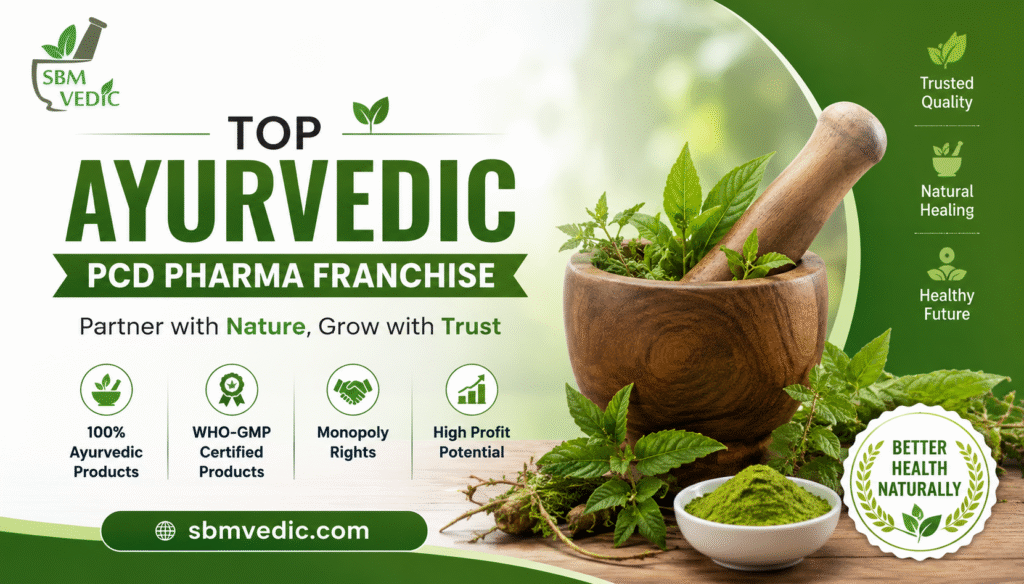


Best Ayurvedic PCD Franchise Company in India

Ayurvedic PCD Company in Uttar Pradesh | SBM Vedic
August 24, 2026Best Ayurvedic PCD Franchise Company in India
Introduction to the Ayurvedic Market
The health and wellness landscape is experiencing a massive transformation, driven by an ever-increasing global shift toward natural, chemical-free healing. As consumers increasingly prioritize organic wellness, partnering with the best ayurvedic pcd franchise company in India has emerged as one of the most lucrative business opportunities. Companies like SBM Vedic are pioneering this growth by combining age-old herbal wisdom with advanced, pharmaceutical-grade manufacturing standards.
Navigating this competitive market successfully requires understanding not just product formulations, but also the high-tech sterile environments—such as cleanrooms equipped with HEPA filtration and precise airflow dynamics—that ensure product safety and regulatory compliance.
Understanding the Ayurvedic PCD Franchise Working Principle
The ayurvedic pcd franchise (Propaganda Cum Distribution) business model enables entrepreneurs, medical representatives, and distributors to market and distribute herbal formulations under an established brand name with low capital investment and minimal financial risk.
- Monopoly Rights: Franchise partners receive exclusive territorial rights, eliminating internal competition within their designated district or zone.
- Low Initial Investment: Unlike setting up a manufacturing plant from scratch, partnering with a franchise allows businesses to leverage ready-made product lines and robust distribution pipelines.
- Comprehensive Support: Parent companies provide extensive marketing tools, visual aids, product samples, and promotional merchandise to accelerate local market penetration.
Advanced Manufacturing Infrastructure: HEPA Filters and Airflow Dynamics
To maintain the absolute purity of herbal extracts and prevent microbial contamination, top-tier manufacturing units integrate high-tech cleanroom technologies. Understanding the operational principles of cleanrooms is essential for evaluating product quality.
Working Principle of HEPA Filters
High-Efficiency Particulate Air (HEPA) filters are critical components in pharmaceutical and herbal manufacturing cleanrooms. By definition, a certified HEPA filter must capture at least 99.97% of airborne particles as small as 0.3 microns.
- Interception: Medium-sized particles following the airflow path brush against the dense mat of randomly arranged glass fiber strands and stick to them.
- Impaction: Large dust or pollen particles travelling at high velocities fail to maneuver around the filter fibers and collide directly into them.
- Diffusion: Ultrafine particles experience erratic, random movements driven by collisions with air molecules (Brownian motion), significantly increasing their probability of getting trapped.
Airflow Velocity and Cleanroom Design
Maintaining sterile production zones depends heavily on controlling airflow velocity horizontal and vertical configurations.
- Airflow Velocity Standards: Cleanrooms maintain strict velocity parameters (typically ranging around 0.36 to 0.54 m/s for unidirectional flow) to sweep away airborne contaminants continuously.
- Horizontal vs. Vertical Airflow:
Horizontal Airflow Systems push clean air across the workspace in a parallel, unidirectional horizontal stream, which is highly effective for localized workstation protection. Conversely, Vertical Airflow Systems circulate air downward from the ceiling toward floor-level returns, minimizing cross-contamination between adjacent processing lines.
Practical Applications, Uses, and Laboratory Relevance
The rigorous standards applied in manufacturing an ayurvedic pcd franchise portfolio extend far beyond commercial distribution, finding critical applications in specialized scientific disciplines.
Uses in Microbiology
In microbiology laboratories, sterile manufacturing protocols and HEPA-filtered laminar flow hoods ensure that microbial cultures, media preparation, and analytical testing remain free from environmental contamination. Maintaining precise airflow velocity prevents rogue spores from compromising sensitive herbal extract assays.
Uses in Tissue Culture
Plant tissue culture heavily relies on aseptic conditions. Micropropagation of rare medicinal herbs requires ultra-clean environments where sterile air filtration prevents fungal and bacterial outbreaks, ensuring genetic stability and high survival rates of regenerated plantlets.
Price Guide and Investment Analysis
Investing in an ayurvedic pcd franchise requires a clear understanding of capital allocation and expected returns:
- Initial Setup Cost: Starting costs are exceptionally budget-friendly, often ranging between ₹20,000 to ₹50,000 depending on initial stock orders and licensing fees.
- Product Pricing Tiers: Bulk manufacturing and competitive wholesale pricing allow franchise partners to maintain high profit margins while offering retail customers affordable wellness solutions.
- Return on Investment (ROI): Due to low overhead expenses, minimal risk, and steady recurring demand for natural supplements, partners typically realize rapid financial payback.
Frequently Asked Questions (FAQs)
Q1: What is an Ayurvedic PCD Franchise?
An Ayurvedic PCD franchise is a business model where a pharmaceutical company grants distribution and marketing rights for its herbal product range to an individual or partner for a specific territory.
Q2: Why are HEPA filters important in manufacturing plants?
HEPA filters eliminate 99.97% of airborne particulate matter down to 0.3 microns, ensuring that herbal medicines and formulations are manufactured in an aseptic, contamination-free cleanroom environment.
Q3: How do horizontal and vertical airflows differ?
Horizontal airflow systems direct filtered air parallel to the work surface from one side to the other, whereas vertical systems move air downward from the ceiling to sweep away contaminants uniformly.
Q4: What makes SBM Vedic a preferred choice for partners?
SBM Vedic offers top-tier formulations, comprehensive marketing support, strict adherence to GMP quality guidelines, and exclusive monopoly rights, ensuring sustained business growth for its associates.
Q5: What is the minimum investment required to start?
The initial investment is minimal, making it easily accessible for fresh entrepreneurs, medical representatives, and established distributors looking to expand their product portfolios.
Related posts
August 24, 2026
August 7, 2026